

"Impressive Animation Marred by a Pagan Mixture of Good and Bad"


| None | Light | Moderate | Heavy | |
|---|---|---|---|---|
| Language | ||||
| Violence | ||||
| Sex | ||||
| Nudity |
What You Need To Know:
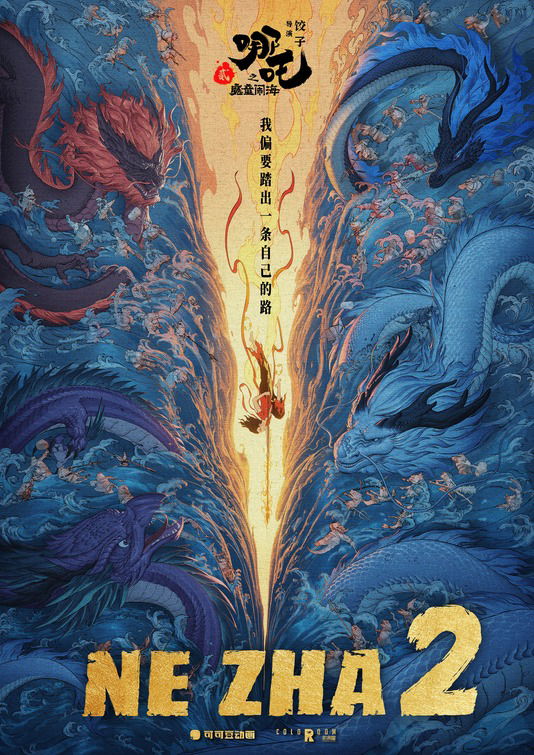
NE ZHA II has exceptional animation with richly detailed visuals and lots of action. However, it has a mixed worldview. The movie combines a story of many Chinese gods, supernatural beings and fantastic monsters with pantheistic themes, frequent strong violence, and some strong moral content. As such, NE ZHA II stresses working together to right wrongs, courage, family, forgiveness, and sacrificial love. The movie’s mixture of false religion and violence with moral, redemptive, pro-family elements creates an excessive, unacceptable combination.
Content:
More Detail:
NE ZHA II, an animated Chinese fantasy, is being released in a dubbed version after having a somewhat successful run early in 2025 in the United States and Canada. NE ZHA and NE ZHA II are loosely based on a popular Taoist folktale in Chinese mythology about a child with special powers who has a curse placed on him before he’s born but eventually becomes a god, even though he has trouble controlling himself. A 1979 movie, NEZHA CONQUERS THE DRAGON KING, is considered a classic work of Chinese animation.
At the risk of being simplistic, Taoism is a form of pantheism, with a splash of polytheism, where the single energy of the universe becomes divided into multiple energies, with the primary division being the yin and the yang, the feminine energy and the masculine energy, with yang being the active, masculine energy and yin being the inactive or receptive, feminine energy. The goal is to learn how to balance all these energies, including the yin and the yang, while remaining true to yourself and letting your identity grow naturally, to live a better life. Taoism also teaches the existence of three primordial gods, or Three Pure Ones, who are the perfect manifestation of the Tao, the natural order of the universe.
In the original movie, which is set in Ancient China, the “Primeval Lord of Heaven,” one of the three highest deities in Taoism, subdues and refines the Chaos Pearl into a Spirit Orb and a Demon Orb. The Lord of Heaven instructs a comical heavenly being, Taiyi, to reincarnate the Spirit Orb into Ne Zha, the third son of a general named Li and his wife, and to watch over the boy.
However, Taiyi’s evil brother, Shen, is jealous of Taiyi. Shen steals the Spirit Orb and magically inserts the Demon Orb into Ne Zha. Meanwhile, Shen inserts the Spirit Orb into Ao Bing, the son of the evil Dragon King.
Eventually, Ne Zha and Ao Bing must work together to unleash the full power of the Chaos Pearl to stop Shen from destroying the village where Ne Zha was born. The released energy destroys their bodies, but Shen’s brother helps them survive as spirits.
NE ZHA II continues the story of Ne Zha and Ao Bing. Reborn through the power of the Seven-Colored Sacred Lotus, their new bodies are fragile.
After Ao Bing’s apparent death, Bing’s father, Ao Guang, the Dragon King of the East Sea, orders Shen to attack the human town at Chentang Pass and blame the chaos on Ne Zha. Bing tries to stop the attack, but his body disintegrates.
Ao Bing’s father offers a truce. Ao Bing and Ne Zha will share Ne Zha’s body for seven days and complete three celestial trials that test their strength, courage and unity to become immortal. By completing the trials, they will win a mystical elixir that can restore Ao Bing’s body and bring peace between the dragon kings and the humans.
Ne Zha and Ao Bing navigate these challenges by taking turns controlling their shared body, confronting dangerous bandits and battling powerful demons. As they progress, long-hidden truths come to light. For example, Shen, their former adversary, discovers that the celestial powers have manipulated events behind the scenes, orchestrating attacks on innocent villages, including his own. This revelation complicates the characters’ understanding of right and wrong.
In the final trial, Ne Zha manages to secure the elixir but is consumed by anger and seeks revenge against the Dragon Kings, planning to imprison them in a magical cauldron. However, when the true villain is revealed, Ne Zha and his allies must fight a climactic battle to defeat the villain and free those he’s oppressed.
NE ZHA II has exceptional animation with richly detailed visuals, fluid character movements, and vibrant, immersive fantasy environments. The sound design complements the visuals perfectly, featuring professional voice acting and a powerful orchestral score that enhances the film’s emotional and mythological depth. The storytelling is well-paced and engaging. It balances intense action with some heartfelt character development. The polished direction and editing create a seamless flow that keeps viewers captivated.
NE ZHA II has a redemptive story that focuses on unity, redemption, courage, and family . Characters must learn to work together, confront past mistakes with forgiveness, face dangerous trials, and protect those they love. Also, the title character’s mother provides an example of sacrificial love.
However, the movie has some concerning elements of significant violence and dark themes. There are several battles where characters use weapons to cut off limbs or kill their opponents. Characters die and leave others to face grief or loss. Gross images of blood, vomit, pee, and Ne Zha’s rear end are shown. Since it is a Chinese legend, the story takes place around their gods, and they often talk about their followers as disciples. Ne Zha is a demon but does not want to be one anymore and talks a lot about choosing who you want to be. At one point, he says, “My fate is mine, not heaven’s plan.” This line appears to be a nod to the Chinese government’s communist and atheist leanings.
All that said, NE ZHA II ends on a hopeful note, with the two heroes united against corruption and ready to face future challenges. And, indeed, an end credits scene suggests there will be a third movie, which makes sense given that NE ZHA II has earned nearly $1.88 billion at the overseas box office. However, the movie’s strong mixture of false religion, dark themes and violence with moral, redemptive, pro-family elements leads to an excessive, unacceptable combination of good and bad.
Share:
 - Content: +1