

"Character Matters"


| None | Light | Moderate | Heavy | |
|---|---|---|---|---|
| Language | ||||
| Violence | ||||
| Sex | ||||
| Nudity |
Watch:

What You Need To Know:
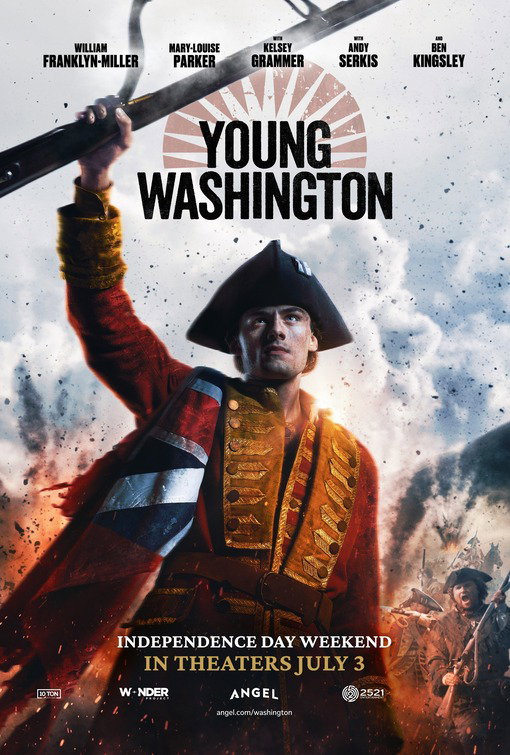
YOUNG WASHINGTON has many intense but not gory scenes of war. However, it’s one of the best, most gripping biographical and historical war movies ever made. YOUNG WASHINGTON has a strong moral, patriotic worldview. It stresses justice and fairness. The movie presents George Washington as an ambitious man. However, George learns, during three famous battles depicted by the movie, that there’s more to becoming a true leader of men than just pursuing personal wealth and recognition. Caution is advised for older children.
Content:
More Detail:
YOUNG WASHINGTON is a superb movie about the early life and career of President George Washinton as he fights the British class system to achieve his ambition to be a respected officer in the British army and discovers in three famous battles there’s more to becoming a true leader of men than just pursuing personal wealth and recognition. YOUNG WASHINGTON is one of the best, most gripping biographical and historical war movies ever made and shows just the right amount of patriotic feeling for one of the most remarkable and admired men in history, whose character and values truly set him apart from his contemporaries. YOUNG WASHINGTON includes a small battle and two major battles, so it has many intense scenes of war, though nothing really bloody or gory.
The movie opens on George during the Battle of the Wilderness (also known as the Battle of the Monongahela) on July 9, 1755. Cut to 12 years earlier, on the day George’s father died. George’s older half-brother, Lawrence, inherits the estate and sadly informs George he can no longer go to the upper class British school because his father was just a tenant farmer. This upsets George because it violates his strong sense of justice. However, Lawrence tells George being a tenant farmer is nothing to be ashamed. He gives George a surveyor’s compass, something his father wanted George to have.
Lawrence takes sympathy toward his younger brother because of the schooling issue. He lets him borrow some classic books, including a book by Cincinnatus, a leader during the Roman Republic who’s often cited for his selfless leadership, civic virtue and public service, and a play about Cato, a Roman politician who supported representative government and opposed tyranny. Lawrence also shows George an English translation of a French book about rules of civility and teaches chess to young George. They discuss the British class system. Lawrence tells George that their family are just pawns, but sometimes a pawn can topple the King.
Flash forward to 1753. Now 20, George has become an expert surveyor. He becomes interested in attending a fancy party at the home of his brother’s rich father-in-law, William Fairfax, to further his career. His mother warns him about attending, but to no avail. At the party, which he secretly crashes, George catches the eye of a young lady at the party, Sarah Cary. She recognizes him as an ambitious man who wants to rise above his station, but they have a good laugh about flaunting or breaking the traditions of the British class system.
Later at the party, George follows Lord Fairfax, who’s trying to escape the party by going into his library. He engages the older man in conversation and offers to travel to Fairfax’s wilderness property in western Pennsylvania and the eastern part of the Ohio Territory to survey it for him. Fairfax agrees.
At a local tavern, George enlists the help of a frontier guide named Christopher Gist. The two head out for the property, but it’s the dead of winter.
During their survey of the Ohio Valley area, George and Chris discover that the French are building a fort on what is clearly British territory. George decides they must hurry back to the Virginia colony to report this to the Governor’s office. At the time, Virginia officials claimed the Ohio Valley as part of the colony’s territory.
On the way back, however, they run into some Indians led by a man known as a leader among the Iroquois Indians who had settled in the Ohio Valley. Their horses spent, George and Chris trade them to the Indians for passage through their land. George and Chris take a boat down a nearby river, but it capsizes in some rapids, and they swim to an small island, where they spend a freezing night. They may have died there, but they wake up in the middle of the night to find the river has frozen over, so they safely make it back to civilization.
George reports to the Governor’s office about the French fort. The lieutenant governor, Robert Dinwiddie, appoints George a Major in the colony’s local militia, but this is not a paid royal commission. In October 1953, he orders George to take some men to the French fort and give the commander a letter demanding the French to leave.
George’s older brother, Lawrence, warns George about taking the job. If he succeeds, the British officers will take the credit, but if he fails, he will be blamed. George decides to go anyway. As history and the Providence of God would have it, George’s decision in 1753 will lead to the French and Indian War and the fateful events of the battle in 1755. George Washington’s actions during that latter battle will forge George Washington’s destiny and begin the legend that inspired a new nation.
YOUNG WASHINGTON is one of the best, most gripping biographical and historical war movies ever made. Except for some timeline issues concerning the biography of George Washington’s older brother and the young woman he starts to woo, the movie seems pretty accurate according to MOVIEGUIDE®’s research. That’s especially true when it comes to events depicted in the three battles portrayed by YOUNG WASHINGTON.
YOUNG WASHINGTON has a strong moral, patriotic worldview. It stresses justice and fairness and the Providence of God. The movie presents the young George Washington as an ambitious man and an adventurer. However, he learns during the three famous battles depicted in the movie that there’s more to becoming a true leader of men than just pursuing personal wealth and recognition. Thus, at one point, he risks his life to save the militia men who served him during the French and Indian War. In that way,
YOUNG WASHINGTON reminds viewers how George Washington created and maintained loyalty from the soldiers under his command and from his fellow countrymen during the American War for Independence from 1775 to 1783. Character matters. The movie also has a prescient theme in its repeated line about chess, that sometimes even a pawn can topple the King. Washington and his fellow patriots did just that in 1783.
YOUNG WASHINGTON has many intense scenes of war. Though they’re not extremely bloody or gory, they do warrant caution for older children.
Share:
 - Content: +2
 - Content: +3
 - Content: +1