


"Classy, Restrained Elegance"

| None | Light | Moderate | Heavy | |
|---|---|---|---|---|
| Language | ||||
| Violence | ||||
| Sex | ||||
| Nudity |
What You Need To Know:
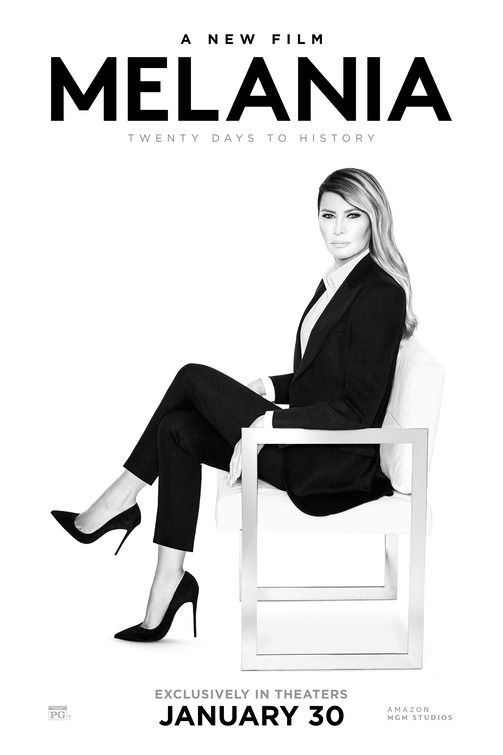
MELANIA offers rare access to the First Lady. The movie remains intentionally distant. As such, it favors elegance and restraint over intimacy and spectacle. This approach may leave some moviegoers wanting more relatable moments. MELANIA is notably free of objectionable content. Instead, it underscores values such as family, dignity, perseverance, modesty, and faith. It also invites thoughtful discussion about character, leadership and integrity under pressure. Ultimately, MELANIA works best as a character study and meditation on public life rather than as a political statement.
Content:
More Detail:
MELANIA is a polished, deliberately restrained feature-length documentary that offers a contemplative portrait of a woman whose public image has long remained very private, restrained and elusive, despite constant exposure in the media. The movie resists polemics and instead relies on atmosphere, visual symbolism and selective access to communicate its themes.
Some may be disappointed to learn that it is not a wider behind-the-scenes look at the pre and post marriage to Donald J. Trump life of Melanija Knavs, Melania Trump since 2005, because the documentary covers only the 20 days leading up to and including Trump’s January 20, 2025 second Presidential Inauguration. Even with the limited period that it examines, the movie effectively pulls back the curtain on the myriad elements of family preparation for the pomp and circumstance of an event of this magnitude and import.
The movie shows Melania working in a realm very familiar to her former role as a supermodel. It shows her helping to design and adjust her wardrobe alongside her longtime designer and stylist, Hervé Pierre. It also shows her planning inauguration festivities with event designer David Monn. Finally, Melania strategizes inauguration logistics and security with White House event producer, Justin Caporale, and the then head of President Trump’s Secret Service detail, Sean Curran.
Throughout the documentary, viewers are shown moments that emphasize routine, discipline and self-control rather than spectacle. Scenes focusing on preparation, such as quiet sequences involving wardrobe choices, staging before public appearances and transitions between private and public spaces, are emblematic of the movie’s approach. These moments, often nearly without dialogue or Melania’s own voiceover narration, reinforce what is unmistakably the movie’s central tension: the contrast between intense global scrutiny and a deeply guarded inner life.
MELANIA also devotes some to the First Lady’s background as an immigrant and her insistence on planning, structure, and order, elements that recur visually and narratively. Rather than offering a chronological biography, the movie uses repetition such as similar gestures, mirrored settings and parallel scenes, to suggest continuity and consistencyin her character. The repetition of these characteristics can feel distant, but it also reinforces the idea that restraint itself is the subject. The camera often lingers on silence, posture and composure, allowing viewers to draw their own conclusions. An interesting visual contrast is created by scenes occasionally intercut with Super-8 footage of Melania’s father, Viktor Knavs, an avid home moviemaker, throughout Melania’s life.
Although the movie presents a rare, yet guarded look at Melania aside the bright lights of her fame, I wanted to see more of Melania the wife, mother, daughter, and human in terms that are more easily identifiable to the common person: in jeans and a T-shirt, barefoot (she eludes to the discomfort of high heels), without makeup, making coffee for herself in the White House residence kitchen, reading a magazine or book with her feet up on the couch, or having an ordinary, motherly conversation with Baron about how school and his social life are going. Instead, we see a lot of the opulence and grandeur of the Trump ecosystem, rooted in an immersive mélange of Gilded Maximalism and Neo-French Grand Manner, styles with which we are very familiar from the wealth of publicity and coverage of Trump’s life and aesthetic philosophy. The world is well acquainted with the Trump lifestyle. However, this movie would have accomplished considerably more by offering better views of a more casual, more intimate Melania,presenting scenes that illustrate the humanity of Melania and her family.
It would also have been interesting to hear Melania converse in the other four languages she reportedly speaks – French (although, in the movie she converses in English with French First Lady Brigitte Macron), her native Slovenian (she also speaks only English with her father onscreen), German, and Italian.
From a Christian and family point of view, MELANIA avoids objectionable content and stresses themes of dignity, perseverance and personal boundaries. The documentary is notably free of explicit material, sensational language, or aggressive ideological messaging. Its tone is calm and measured, making it suitable for mature family viewing, particularly for households interested in discussing character, vocation and the cost of public life.
Christian audiences may also appreciate the movie’s implicit respect for privacy, modesty and restraint, values that align with a faith-based emphasis on inner life over outward display. We also don’t see more intimate signs of Melania practicing her Roman Catholic faith, other than a visit to St. Patrick’s Cathedral in New York, a place her mother Amalija held dear and visited frequently before her passing in early 2024. While the documentary does not explicitly address faith, morality or theology, it repeatedly highlights discipline, responsibility and endurance under pressure. These qualities can serve as conversation starters for families about humility, the burden of leadership, and the importance of integrity when words are few and actions are closely watched.
At the same time, viewers approaching the movie from a Christian perspective should understand that MELANIA is not a moral argument or a testimonial. It neither praises nor condemns overtly. Instead, it presents a study in self-possession and invites discernment rather than reaction. The absence of overt critique or confession may frustrate certain audiences, but others will find that the movie’s quietness allows space for reflection rather than judgment.
A particularly moving scene shows Melania meeting with Aviva Siegel, recently released from captivity by Hamas, physically and emotionally comforting Siegel, deeply grieved by her husband of 44 years, Keith’s, continued captivity at the time of the filming. The movie later credits Melania as being instrumental in Keith’s release from captivity in February of 2025.
The musical soundtrack is a mixture of some of Melania’s favorite pop music (Michael Jackson, Spandau Ballet, Rolling Stones, Elvis, and Boney M.), along with Bach, Mozart, Ravel, and incidental music composed by Tony Neiman. The music effectively accentuates the movie’s content, helping shape the mood of each scene. Two of the rare moments we see behind the tightly measured façade are Melania singing along with Jackson’s “Billie Jean” while riding in a limo, and dancing backstage to the Village People’s “YMCA,” a staple Trump theme song.
Ultimately, MELANIA works best when received as a character study and a meditation on public life, not as a political statement. For families and faith-oriented viewers, it offers an opportunity to discuss how character is formed under pressure, how silence can communicate as powerfully as speech, and how dignity can be maintained even amid controversy. In that sense, the documentary’s restraint is not a weakness, but its defining feature, one that encourages thoughtful viewing and measured conversation long after the movie ends.
So far MELANIA has a 10% critics rating on Rotten Tomatoes, yet a 99% audience rating, and a $7 million-plus opening weekend, rare for a documentary – dismissed by critics, embraced by audiences, the clearest sign that it’s striking the right nerve.
 Add Movieguide® as preferred on Google
Share:
 - Content: +4
 - Content: +2
 - Content: +4
 - Content: +4