

"Mixed Marital Drama, with a Nice but Understated Ending"

| None | Light | Moderate | Heavy | |
|---|---|---|---|---|
| Language | ||||
| Violence | ||||
| Sex | ||||
| Nudity |
What You Need To Know:
MIDWINTER BREAK is a slow-moving but engrossing, well-acted character study of a long marriage. The scenes are understated, but the third act ratchets up the dramatic conflict and concludes with a touching, hopeful final scene. However, MIDWINTER BREAK doesn’t really resolve the married couple’s personal issues and differences. The wife’s longing to use her Catholic faith to “make a difference” is left hanging, as is the husband’s atheism and personal self-loathing. MIDWINTER BREAK also has some foul language and an implied bedroom scene. So, MOVIEGUIDE® suggests extreme caution.
Content:
More Detail:
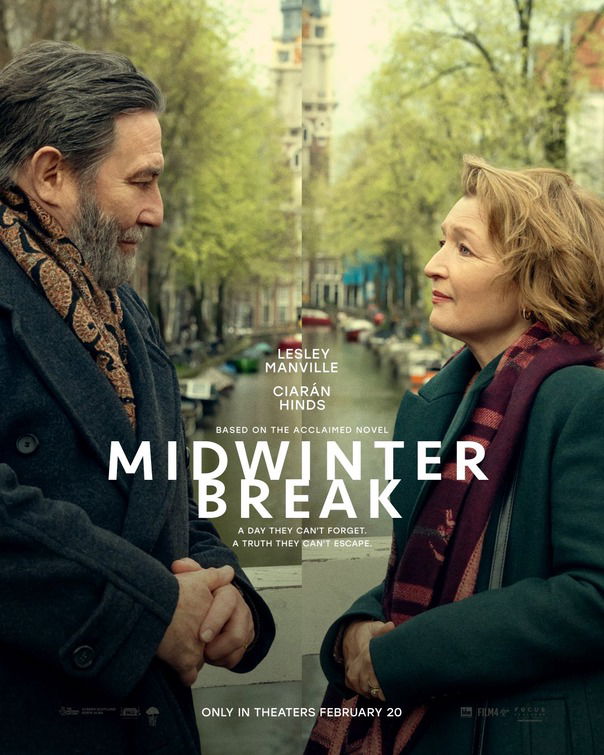
MIDWINTER BREAK is a British drama about a seemingly contented elderly Irish couple living in Glasgow, Scotland who take a Christmas holiday to Amsterdam, where they find that their religious and lifestyle differences, and past trauma, are coming between them. MIDWINTER BREAK is a slow-moving but engrossing and well-acted character study of a long-time marriage, but the movie and its script don’t really resolve the married couple’s personal issues and differences, the wife’s longing to use her Catholic faith to “make a difference” is left hanging, as is the husband’s personal self-loathing, and there’s some foul language and an implied bedroom scene.
MIDWINTER BREAK is set in an increasingly secular, and sad, world. It stars Lesley Manville as the wife, Stella, and Ciarán Hinds as Gerry, the husband. Act One shows Stella going alone to mass at her local Catholic Church during Christmas, while Gerry sits at home reading, drinking whiskey, listening to music, and falling asleep. That, apparently, is their routine.
During that sequence, the movie inserts a flashback where 40 or so years ago, Stella is accidentally shot during a gunfight between Protestant and Catholic factions that suddenly breaks out near a park where Stella is walking. The bullet goes through the left side of her abdomen. Baby and mother survive, but Stella and Gerry decide to leave Ireland and move to Glasgow, Scotland.
At Christmas, Stella surprises Gerry with a four-day holiday to Amsterdam. Gerry is pleasantly surprised, and they visit Amsterdam in February.
In the city, Stella becomes interested in a hidden section of Amsterdam where a lay sisterhood of persecuted Catholic women established a sanctuary from Protestant persecution. Gerry accompanies her on the first day she visits. However, when Stella wants to visit another day, Gerry doesn’t go. Instead, he wanders the city, visits a record store and ends up at the local Irish pub they found the first evening.
All this brings out a hidden conflict between Stella and Gerry. He’s a stubborn atheist critic of all religion. Meanwhile, she’s tired of his frequent drinking, even though the movie never shows hm drunk. She’s also tired of his disdain for her faith. So, Stella tells Gerry that she thinks it might be best if they sold their flat and got a divorce. Can they save their marriage?
MIDWINTER BREAK is a slow-moving but engrossing character study of a long-time marriage that’s suffering a sudden breakdown. The third act ratchets up the dramatic conflict and concludes with a touching, hopeful scene that celebrates new life and displays the biblical notion of marriage where two people become one flesh.
However, all the scenes in MIDWINTER BREAK are rather understated, without much really strong emotive power. Also, the movie doesn’t resolve all the married couple’s personal issues. For example, the wife’s longing to use her Catholic faith to make more of a “difference” in the world is left hanging. Also left hanging is a statement by the husband that, as he drinks, he’s plagued by feelings of self-hatred. No further explanation is offered for this self-loathing. If you’re going to bring up something as monumental or dramatic as that in your dialogue, you have to give viewers and readers more of an explanation, elaboration or some context. Finally, although MIDWINTER BREAK ends with a slightly touching and hopeful last scene of an enduring marriage, the last scene still seems a too anticlimactic and, again, doesn’t really or fully resolve any of the conflicts driving the married couple apart. Thus, MIDWINTER BREAK has a mixed pagan worldview with Christian AND humanist content.
There’s another little piece of dialogue in the movie that’s rather annoying and anticlimactic. In one poignant scene, Stella and Gerry briefly debate her Catholic faith versus Gerry’s obstinate atheism and hospitality toward faith. At one point, Gerry asks her why can’t she just accept “my truth” and have her own truth, and leave it at that? Stella never really answers Gerry’s question. So, his question just hangs there, unresolved. Even more bothersome, however, is that the idea of My Truth versus Your Truth is an inherently irrational and nonsensical idea that’s often brought up by atheists and agnostics who are ignorant or inexperienced with philosophical debates. There’s actually no such thing as “My Truth” versus “Your Truth.” The idea of Truth is definitionally totally objective and not subjective. Linguistically, rhetorically, rationally, psychologically, and pragmatically, Truth is a proposition or conclusion, a declarative statement, that is either True or False. For example, Christianity is either True or False, and God either exists or He doesn’t exist. So, Stella’s Christian faith and Gerry’s atheism cannot both be true, though they both may be false. There is no My Truth and Your Truth. There is only THE Truth, and Truth is objective, transcendent, eternal, and true for everyone. It exists and corresponds to Ultimate Reality, whether or not you personally believe it.
Finally, MIDWINTER BREAK also has some brief foul language and a bedroom scene that implies the married couple have a satisfying night of marital bliss. So, the problems between Stella and Gerry seem to have nothing to do with physical incompatibility.
That said, the last scene saves the movie from being a total downer. Even so, MOVIEGUIDE® advises extreme caution.
Share:

 - Content: +1

 - Content: +1