
"Absolute Power Corrupts Absolutely"


| None | Light | Moderate | Heavy | |
|---|---|---|---|---|
| Language | ||||
| Violence | ||||
| Sex | ||||
| Nudity |
What You Need To Know:
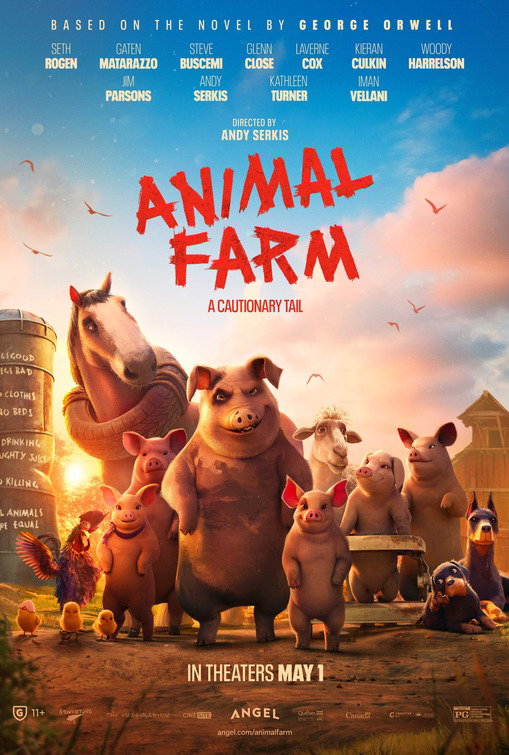
ANIMAL FARM is a well-made adaptation of George Orwell’s original novel. It keeps the novel’s depiction of Napoleon and his porcine sycophants as Stalinist, communist tyrants who make the other animals work hard while they enjoy all the benefits of their labor. However, the movie’s addition of a greedy female business owner trying to establish a monopoly adds a critique of modern consumer society. ANIMAL FARM has some jokes about passing gas. It also has some scary action violence. So, MOVIEGUIDE® advises caution for pre-teenage children.
Content:
More Detail:
ANIMAL FARM is an animated version of George Orwell’s 1945 satirical fable mocking Joseph Stalin, Marxist Leninism and the Soviet Union, which is about animals taking over a farm, with the pigs hijacking the revolution and acting like selfish tyrants, but the new movie adds a naïve young pig character duped by the older Stalinist pigs and changes one of the neighboring farmers into a female owner of a huge conglomerate building an agricultural and consumer monopoly that will take over the Animal Farm. A good adaptation, ANIMAL FARM keeps the novel’s depiction of Napoleon and his porcine sycophants as Stalinist tyrants who make the other animals work hard while they enjoy all the benefits of their labor, but the movie adds a critique of modern consumer society and contains some scary action violence that warrants caution for pre-teenage children.
The movie opens with the animals owned by drunken farmer Mr. Jones being herded onto a train while a bank manager named Mr. Whymper forecloses on the farm. A wise pig named Snowball has taught a little piglet named Lucky how to read. Lucky tells the other animals that the sign on the train reads “Laughter House.” “I love to laugh,” a pompous fat pig named Napoleon says as he hops joyously onto the train.
However, one of the men loading the animals on the train moves a door obscuring one letter on the sign. Snowball comes along and, in a panicked voice, says the sign actually says “Slaughter House.”
The animals start jumping off the train. They all decide to revolt and take over the farm. They easily run Mr. Whymper and a drunken Mr. Jones off the farm.
Now in charge, the animals wonder how they’re going to run things and feed themselves. Everyone agrees that Snowball is the one to lead them all.
So, Snowball writes seven rules on the farm’s water tower. One rule is, “All animals are equal.” The other laws include “Four legs are good; two legs are bad. No animal should sleep in a bed. No animals shall drink naughty juice,” or alcohol.
Working together, the animals turn the farm into the most successful farm in the area, except for the corporate farm owned by a devious woman named Freida Pilkington. The animals don’t know that it was Freida who was working with Mr. Whymper to take the farm away from Mr. Jones.
When Snowball decides they need to save some grain for the winter and build a windmill, Napoleon thinks he knows better. He’s been training the dogs on the farm to be police dogs. So, he starts a propaganda campaign against Snowball and gets the other animals to vote against the windmill. Worse, Napoleon uses his vicious dogs to take Snowball away, who never returns.
Then, Napoleon and his pig buddies, including the naïve Lucky, steal the profits from the farm sales. They take the profits to Freida’s big outlet store to buy things. When Napoleon finds out that some of the things he wants require electricity, he takes Snowball’s plans to build a windmill and pretends he’s the one who came up with the idea. Napoleon forces the other animals to build the windmill. Not only that, but he decides to buy a fancy car. That means, he needs to learn how to walk on two legs.
So, Napoleon starts changing the seven rules. For example, the pigs now write, “Four legs good, two legs better,” and “No animal shall drink naughty juice to excess.” They also start living in the farmhouse, wearing clothes and sleeping in beds.
Things come to a head when Freida seduces Napoleon into supporting her plans to build a huge dam so that they can control all the farms. Secretly, she plans to start selling the animals to the local glue factory and take them to the slaughterhouse.
However, Lucky and the other animals decide to revolt as they realize that the pigs are no better than the humans that oppressed them. “All animals are equal, but some animals are more equal than others.”
The original ANIMAL FARM novel by George Orwell is a brilliant critique of the Soviet Union and the 1917 Russian Revolution based on Orwell’s experiences and knowledge. As such, it was also a critique of communist tyranny in general, and Stalinist tyranny specifically. Despite this, Orwell was a proponent of “democratic socialism” and opposed free market capitalism. For example, Mr. Pilkington, the owner of the biggest farm next to the farm run by the pigs, represents the aristocratic and economic corruption Orwell saw in Great Britain and its capitalist system. In the novel, Pilkington and the pigs create an alliance to oppress the other animals, but they end up fighting among themselves.
So, Orwell didn’t just oppose communist totalitarianism, he also opposed capitalist totalitarianism and all imperialist tyranny. Apparently, his favored political ideology was a utopian form of “democratic socialism” where people democratically “control” the government and have freedom of speech and thought, but the government controls major industry and enforces a rough “equality” of incomes. MOVIEGUIDE® believes Orwell’s democratic socialism was utopian, because he never really pinned down how exactly he would want society to be run under a system of democratic socialism. That said, before his untimely death in 1950 at age 46, Orwell remained a staunch critic of all forms of political propaganda and even created some principles by which people could remove all political propaganda from their thinking, speaking and writing. He was skeptical of all forms of political hegemony and oppression.
The new ANIMAL FARM movie still has the critique of Soviet-style communism that’s in Orwell’s original novel. However, it’s more of a general satire of totalitarianism or authoritarian tyranny. Thus, ANIMAL FARM turns the Pilkington character into a rich monopolist capitalist who wants to control all production, including all agricultural production, and all consumer sales. Freida imagines her company as a monopolistic Amazon website that runs all agriculture and production of goods.
Thus, ANIMAL FARM keeps the novel’s depiction of Napoleon and his porcine sycophants as Stalinist tyrants who make the other animals work hard while they enjoy all the benefits of their labor. So, the movie still shows that the pigs become just like the humans who oppress the animals. However, by turning Mr. Pilkington into a tyrannical owner of a monopolistic agricultural conglomerate, the movie offers a socialist critique of modern consumer society. Also, a note at the end of the credits takes a stand against all “oppressors” to side with anyone who feels “oppressed.” This language of oppressed versus oppressor mirrors the modern Woke Marxist propaganda that’s running rampant in today’s society and that demonizes anyone who opposes or even just questions Woke Marxist propaganda. Such language seems to violate Orwell’s own warnings about using propagandistic language, from the left or from the right. You can see Orwell’s attitude on propaganda and language in this article, “Politics and the English Language” by George Orwell at https://www.orwellfoundation.com/the-orwell-foundation/orwell/essays-and-other-works/politics-and-the-english-language/.
All in all, ANIMAL FARM has a strong moral worldview opposing communist tyranny. There’s also the strong pro-capitalist segment where the animated animals work hard and run a successful farm that makes a lot of money and profit selling farm goods to people. However, ANIMAL FARM also has some Romantic, socialist elements exposing and condemning the evils of modern consumer society and large monopolistic conglomerates. “Power tends to corrupt, and absolute power corrupts absolutely.”
ANIMAL FARM has no foul language or lewd content. There are, however, some jokes about passing gas. Also, the movie has some scary action violence such as animals and humans in peril from a huge flood. So, MOVIEGUIDE® advises caution for pre-teenage children. While the movie contains no excessive elements, parents will want to exercise caution. Despite the movie’s animation, the worldview complexities will not appeal to younger children.
Share:

 - Content: +4
 - Content: +1
 - Content: +2
 - Content: +1