

"Mixed Pagan Worldview with Some Moral, Pro-Family Content"


| None | Light | Moderate | Heavy | |
|---|---|---|---|---|
| Language | ||||
| Violence | ||||
| Sex | ||||
| Nudity |
Watch:

What You Need To Know:
MOANA the movie has some moral, pro-family and redemptive values. The young heroine exhibits strength, kindness, selflessness, sacrifice, and a desire to protect her people. She also encourages Maui to be a hero who’ll give up his own self-interest for the wellbeing of others. There are some serious problems areas, however. For example, MOANA has a mixed, very pagan worldview. The moral, redemptive content mentioned above is diminished by the movie’s polytheistic ideas. There are multiple references to gods, including a lava monster god and a goddess of nature, and the hero is called a demigod. Because of that, MOVIEGUIDE® advises strong or extreme caution.
Content:
More Detail:
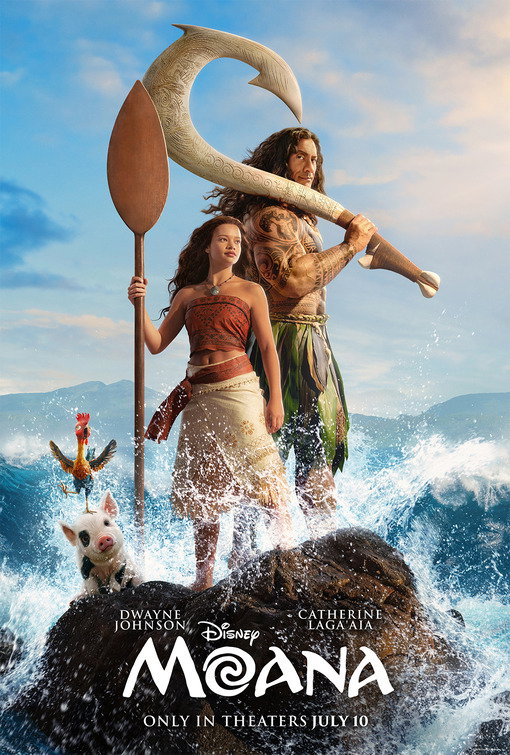
MOANA is a live-action version of the 2016 animated movie about a Polynesian girl who bravely goes sailing to find the shape-shifting demigod Maui so he can restore the life force of the goddess of nature, a living island that brought life to the ocean. The live action MOANA has an epic, operatic feel that serves its fantasy adventure story well, with a personal story that’s filled with lots of great music, great songs, spectacular visuals, and funny comedy, but the movie a bit too long and drags in the middle, and its moral, redemptive elements are mixed with false polytheistic religion and some scary parts.
Moana is the chief’s daughter and is preparing to one day be the leader of her people on their peaceful island. However, her desire to be out on the open ocean troubles her father, who’s afraid she’ll be killed. Moana’s grandmother warns her of impending doom that may happen to their people because of a legendary story that’s been passed down by generations.
As the story goes, in the beginning, the earth was just water, until Te Fiti, the goddess of nature, rises from the ocean as a living island. Using a small magical stone, Te Fiti brings life to the world. One day a demigod trickster and shapeshifter named Maui steals the stone, but a giant lava monster confronts him, and Maui loses the stone and his giant magical fish hook to the ocean depths. With the stone separated from Te Fiti, death begins to creep into the ocean.
A thousand years later, death starts to affect Moana’s island. He grandmother warns that the destruction of their home is impending, unless someone can return the stone to the heart of Te Fiti. Her grandmother also reveals that the ocean has chosen Moana to be that savior. Dhe gives Moana the magical stone in a necklace. Inspired by the history of her ancestors as sea navigators, Moans grabs a large ancient sailboat and sets out into the ocean to enlist Maui to help her on her quest.
The ocean leads Moana onto the desert island where Maui has been stuck. When Moana tells Maui of her mission, he immediately refuses, wanting nothing to do with a “little girl,” even though Moana is now 16. Completely full of himself and all that he’s done for humanity as a hero, Maui thinks everyone should already be grateful for him. In reality, however, he just doesn’t want to face the giant lava monster.
Can Moana persuade Maui to help her save the world and her people from impending doom?
The live action MOANA has an epic feel that serves its fantasy adventure story well. At the same time, the movie is a personal, operatic drama with lots of great music, great songs, spectacular visuals, and funny comedy. That said, MOANA is a bit too long and drags in the middle. Also, the acting is fine, but, ultimately, the story is better suited to animation rather than live action.
MOANA the movie has some strong moral, pro-family and redemptive values. The young heroine exhibits strength, kindness, selflessness, sacrifice, and a desire to protect her people. She also encourages Maui to be his best, a hero who’ll give up his own self-interest for the wellbeing of others. In addition, the ending stresses repentance and forgiveness.
There are some problems areas, however. For example, MOANA has a somewhat mixed, pagan worldview. The moral, redemptive content mentioned above is diminished by the movie’s polytheistic ideas. Thus, there are multiple references to gods, including a lava monster god and a goddess of nature, and the hero is called a demigod. That said there’s a hidden truth, however, in the movie’s depiction of the lava god and the earth goddess that’s rather nifty. This hidden truth helps solve the movie’s plot problem at the climax. Finally, the ocean is depicted as a living thing with a mind or consciousness of its own, which reflects the animistic nature of pagan religious beliefs.
Even so, however, the movie is false when it assumes that Polynesian religion or mythology is totally polytheistic and animistic. For example, in looking at the major creation myths in Polynesian societies, one finds two interesting stories. In one of the stories, the Sky and the Earth are two distinct divine entities that need to be pushed apart, or separated, by another powerful, benevolent God for light to enter so that this third god can create life on Earth.
In the second story, there is an original, powerful, benevolent Supreme God named Io or Po, who creates the Sky and the Earth and separates the Light from the Darkness to create life. These two stories sound somewhat similar to what the Bible says in Chapter One of the Book of Genesis about how God, through the power of the Holy Spirit, declared “Let there be light” and then had to separate the light form the darkness in order to create life on the land and in the sea. Could there be a cultural memory in Polynesian society about the biblical story of Creation?
MOANA also has some scary moments to go along with its polytheistic religious themes. Because of all that, MOVIEGUIDE® advises strong or extreme caution.
 Add Movieguide® as preferred on Google
Share:

 - Content: +3

 - Content: +1